What is Deep Brain Stimulation?
Deep brain stimulation (DBS) works by targeting one of several
areas in the brain that are part of the movement disorder pathway.
By placing a fine wire (electrode) very precisely within the
desired area, we are able to introduce a small amount of electrical
current to these areas, which causes deactivation of the nerve
cells. This electrode is connected to a battery which is implanted
under the skin, allowing a small pulse of electricity to be delivered
24 hours a day. The most commonly targeted regions are the subthalamic
nucleus (STN), thalamus (Vim), pallidum (GPi), and pedunculopontine
nucleus (PPN) in Parkinson's disease, the thalamus (Vim) for
essential tremor, multiple sclerosis tremor, the pallidum
(GPi) in dystonia and tourette's syndrome.
What are the goals of DBS surgery?
The aims of DBS are as follows:
Reduction of abnormal involuntary movements
Improvement in function
Reduction of medications (or medication side effects)
Improvement in quality of life
Which conditions is it used to treat?
DBS is used to treat several types of movement disorders:
Parkinson’s disease
Essential tremor
Dystonia (including spasmodic torticollis or “wry neck”)
Post-traumatic dystonia and tremor
Multiple sclerosis tremor
Tourette’s syndrome
What are the advantages of deep brain stimulation?
DBS is an important and useful neuromodulation technique. It is
generally:
Highly effective
Minimally invasive
Associated with few and infrequent side effects
Non-destructive (unlike most other forms of surgery)
Reversible
What are the reasons for surgery?
When medications are no longer working well, or their side effects
are to severe, surgery may be of value.
Clinical studies and experience suggest that surgery should be
considered early rather than late, due to the high likelihood of
developing severe medication side-effects with long-term treatment,
better outcomes with earlier surgery, and a higher chance of avoiding,
delaying or minimising the economic and social side-effects associated
with advanced movement disorders.
What are the alternatives to surgery?
At present, the only alternatives to surgery are medications. You
should check with a movement disorder neurologist to ensure that
you have tried all of the appropriate medications before seriously
considering surgery.
Before your admission to hospital
Before you are selected for DBS surgery, you will undergo an extensive
series of assessments and investigations. Most of these are performed
as an outpatient (no hospital admission required). You will be
reviewed by a neurologist with specific training and expertise
in this area, and also by a neurosurgeon, Dr.
Richard Bittar.
As an outpatient, before surgery you will also have:
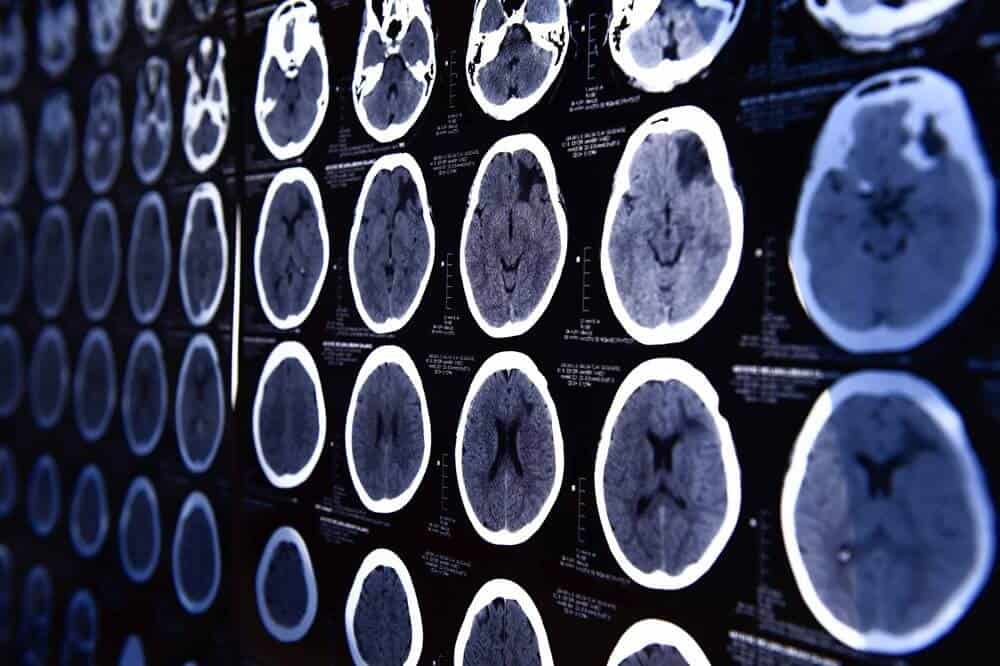
An MRI scan. This helps us to map your brain for the surgery
so we can clearly see the areas to target during the operation.
A Neuropsychology assessment. This will include an assessment
of your suitability for this operation.
A Clinical Psychology assessment. This will include an assessment
of any potential depression or anxiety (both of which also may
require treatment), as well as your suitability for this operation.
Other investigations and consultations will be arranged as
necessary.
What do you need to tell the doctor before surgery?
It is important that you tell your surgeon if you:
Have blood clotting or bleeding problems
Have ever had blood clots in your legs (DVT or deep venous
thrombosis) or lungs (pulmonary emboli)
Are taking aspirin, warfarin, or anything else (even some
herbal supplements) that might thin your blood
Have high blood pressure
Have any allergies
Have any other health problems
Special precautions
It is important that you stop certain drugs before surgery, especially
ones that thin your blood. If you are taking aspirin, warfarin,
or other blood-thinning agents (including herbal products) it
is very important that you contact us two weeks before your admission
so that we can discuss stopping them with you. If you are taking
warfarin we may need to admit you earlier but each case varies,
so it is important that you phone and we can discuss the plan
for you.
What are the specific risks of this type of surgery?
As with all types of surgery, there is a small chance of complications.
There is a 2-3% chance of stroke or haemorrhage from this
procedure
There is a small risk of infection (3%)
Seizures are very uncommon
There could be movement of the electrode, and it may need
to be replaced in a separate procedure
Failure of the stimulator
The risk of death is extremely small (less than 1 in 100)
What are the risks of anaesthesia and the general risks
of surgery?
Significant scarring (‘keloid’)
Wound breakdown
Drug allergies
DVT (‘economy class syndrome’)
Pulmonary embolism (blood clot in lungs)
Chest and urinary tract infections
Pressure injuries to nerves in arms and legs
Eye or teeth injuries
Myocardial infarction (‘heart attack’)
Stroke
Loss of life
Other rare complications
What does the operation involve?
This is done in 1 or 2 stages, sometimes several days or weeks apart. Your
admission will be for approximately 3-4 days for each procedure.
Stage One (Electrode Placement)
The first operation (Stage 1) involves placement of special wires
(electrodes) in specific regions of the brain. We target one
of several areas in the brain, depending on your clinical condition.
In Parkinson's disease and dystonia, an electrode is implanted
on each side of the brain in the majority of cases. To target
these small areas of the brain accurately we have to use a
type of surgery called stereotaxy.
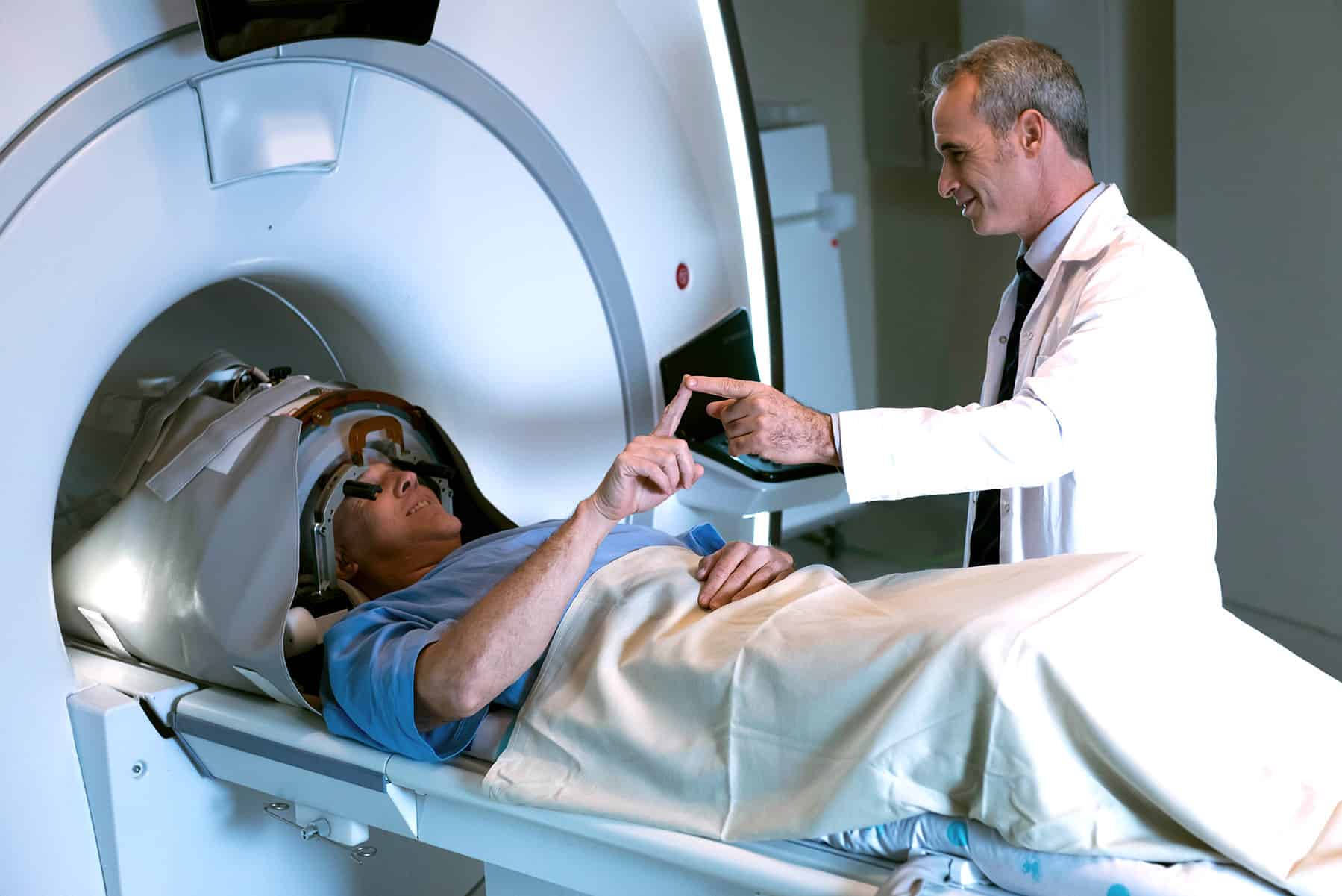
Before surgery you will have a special frame attached to your
head. This is usually done with local anaesthetic and sedation,
and is not too bothersome. The frame must stay on for the surgery,
but will be removed as soon as it is over. You will usually be
awake for the surgery so that we can use changes in your tremor,
stiffness, and slowness of movement to guide the final position
of the electrode. Some patients with dystonia will be given a
general anaesthetic for the entire procedure (ie. will be asleep).
Then you will have a CT scan (which will be fused with your preoperative
MRI to help us to locate the specific areas in relation to the
metal frame) before being taken to the operating theatre. Some
more local anaesthetic and some light sedation will be given
before one or two small holes are shaved in your skull. This
does not hurt, and is usually much less uncomfortable than going
to the dentist!
The electrode is then slowly inserted and the electrical activity
will be monitored to guide its final placement. Once we are confident
that we are in the correct position, we will stimulate through
the tip of the electrode to see whether this helps and too look
for side effects. We then secure the electrode in place (by a
special plastic cap attached to your skull beneath the skin).
A CT brain is performed immediately after surgery to confirm
satisfactory electrode placement and to rule out significant
bleeding or other problems. This procedure takes several hours.
In some cases, where the clinical improvement is perfect during
the initial stage and there is enough time to do so, we will
proceed directly to the second stage (battery implantation).
If the results of testing during the surgery
are unclear, we will bring temporary extension leads out through
the skin, and will conduct further testing after surgery to see
whether the stimulation is producing a benefit. In such cases,
Stage 2 will be performed once the benefits of surgery (and absence
of significant side effects) are clear.
Stage Two (Battery Implantation)
Implantation of the battery (implantable pulse generator or ‘IPG’)
is usually done several days or weeks after Stage 1. If the timing
is only a few days, you will remain in hospital during this time;
otherwise you will be discharged and readmitted.
This second operation (Stage 2) involves giving you a general
anaesthetic (ie. you will be asleep for the procedure. A small
incision is made over your scalp, and a slightly longer incision
just below your collarbone. The ends of the electrodes which
were inserted into you brain at the first operation are then
connected to extension leads, which are tunneled under the skin
from your head to your chest. They are, in turn, plugged into
a the battery which is then placed under the skin just below
your collarbone (sometimes this is placed in your abdomen or
flank). The end result is that the electrodes, extension wires,
and battery will all be underneath your skin. If you are a fairly
thin person, a modest ‘bump’ will be visible over
your chest where the battery sits (this is rarely noticeable
when wearing clothes).
Your battery will be programmed over the next couple of days
so that the stimulation you receive will be best for your movement
disorder. Your neurologist will adjust your stimulation settings
and medications progressively over a number of months.
What happens after I am discharged from hospital?
You should be ready for discharge from hospital 1-2 days after
the second operation. Your GP should check your wounds 4 days
after discharge. We will advise you when to have your stitches
removed at your GP's surgery or by the Precision Neurosurgery
Practice Nurse. You will need to take it easy for 6 weeks.
You should do an hour of gentle exercise, such as walking, every
day. You should not sign or witness any legal documents until you
have been seen by your GP. You will be reviewed after 6-8 weeks
by your neurosurgeon. You should not drive a motor vehicle or operate
heavy machinery your neurosurgeon gives you the go ahead.
There are some restrictions on the types of scans you can have
once the stimulator has been inserted (ie. MRI scans). You will
also be given detailed information about other things you must
avoid, such as metal detectors at airports. It is critical that
you read such information thoroughly. There may be some other restrictions
on what you can and cannot do, and these will be discussed with
you before surgery or during your hospital stay.
What follow-up is required?
Your neurosurgeon and neurologist will keep in close contact with
you after your discharge from hospital and can alter your stimulation
if necessary to maintain a good effect. The battery life will
vary depending on your stimulation settings (on average the battery
will last between 2-4 years). We will need to see you at least
once a year to check the battery.
How successful is surgery?
Surgery for movement disorders frequently results in a reduction
in symptoms and signs, an improvement in quality of life, and
a reduction in medication intake. Some patients are able to return
to their previous occupation following successful treatment.
Surgery does not return you to "normal" however, and
it is important that you understand this before going ahead.
Overall, the majority of patients will significantly benefit
from surgery, whilst a minority will not derive a significant
improvement.
How long will the benefits last?
This will vary from patient to patient. Typically, patients obtain
a benefit for 5 years or longer. The benefit gradually decreases
with time (due to progression of the underlying disease). A small
proportion of patients may benefit from repeat surgery if the
benefits drop off.
What should you notify your doctor of after surgery?
Increasing headache
Fever
Swelling or infection of the wounds
Leakage of fluid from the wound
Fitting (seizures)
Abnormal sensations or movements in your face, arms or legs
Weakness or numbness
Drowsiness
Any other concerns
What are the costs of surgery?
Private patients undergoing surgery will generally have some out-of-pocket
expenses.
A quotation for surgery will be issued, however this is an estimate
only. The final amount charged may vary with the eventual procedure
undertaken, operative findings, technical issues etc. Patients
are advised to consult with their Private Health Insurance provider
and Medicare to determine the extent of out-of-pocket expenses.
Separate accounts will be rendered by the anaesthetist and sometimes
the assistant, and hospital bed excess charges may apply. Medical
expenses may be tax deductible (you should ask your accountant).
You should fully understand the costs involved with surgery before
going ahead, and should discuss any queries with your surgeon.
What is the consent process?
You will be asked to sign a consent form before surgery. This form
confirms that you understand all of the treatment options, as
well as the risks and potential benefits of surgery. If you are
unsure, you should ask for further information and only sign
the form when you are completely satisfied.